
What's Involved In Creating Sailboat Race Photographs?

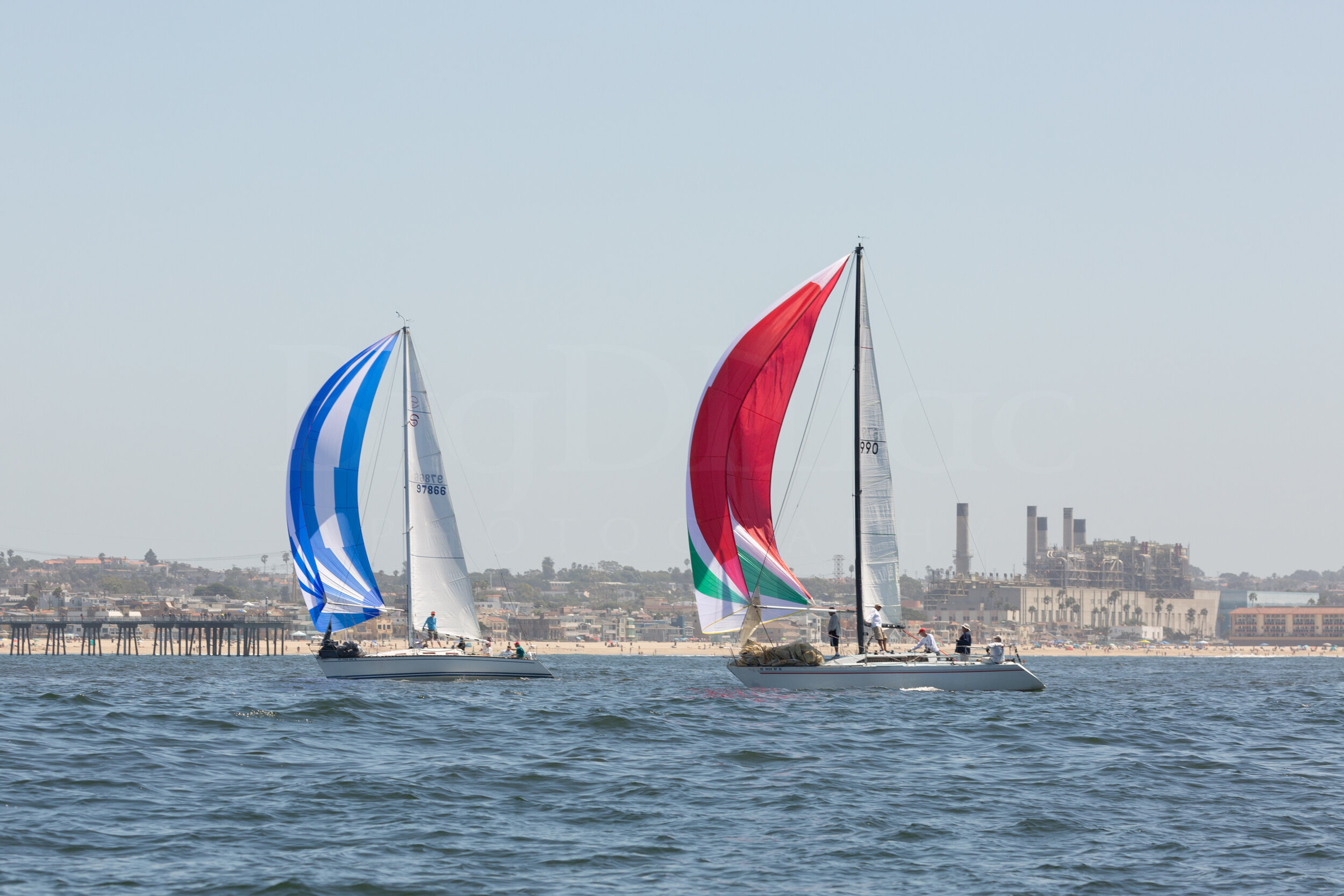
King Harbor Yacht Club Race Weekend Start Line
Watching a slide show with your boat and crew members, along with other competitors’ boats in close competition, is usually an experience racers look forward to enjoying after a full day on the ocean. Sailboat race photography can enhance any after-race gathering, with racers “ooo”-ing and “awwww”-ing over drinks and food. This end result is the outcome of lots of planning and physical hard work before the images ever grace a race club’s TV screens. Below is an explanation of what happens behind the scenes to capture the kind of photos that many racers have come to expect.
A Week Before A Race
When a Race Committee member places a call to ask me if I am available on a certain date or dates to shoot a race, the wheels are put into motion. First, for me, anyway, is to make sure that the chase boat and skipper I prefer is also available. Once that is secured, the foot work begins.
The week before a race, the chase boat has to be prepared. The skipper has to make sure there is a full tank of gas. (If it is half full, then a trip to the gas dock is in order.) As soon as that can be done, I pick up a race course, and the marks are inputted into the GPS (if they are not already in the system). A course map is studied by the skipper, to visualize where she will follow racers, and which side of the Race Committee Boat to hang out at in order to capture the start-line photos. Also, the course map helps guide the skipper as to where she can predict the racers may tack, and which side of the boats they will turn at the marks. This is important for a couple of reasons: 1) we do NOT want to interfere with the race in any way; getting in the way of racers can impede their times, could cause accidents, and could lead to protests by the racers, something we do NOT want to be responsible for and 2) I am trying to get that perfect shot at the right angle. Knowing where to drive, the skipper can get me where I need to be at the right moment for that money shot! Actually, it is very important that the chase boat skipper also have experience with sailing, so they have first-hand knowledge of wind and speed, and can use that knowledge to predict where, when and how racers will tack and gybe.
The Day Before A Race
A run to the food market is made the day before a race to stock the boat with water, iced teas and healthy snacks to keep both the skipper and photographer hydrated, alert, and nourished each day. Last-minute packing is done the day before, too: extra jackets, hats, sunscreen, SPF lip balm, and anything else either of one us can think of that we might need. The day before is also spent getting all camera gear ready. Memory cards need to be formatted and stored in the camera bag. Preferred lenses specific to the kind of race and sailboat designs are chosen, cleaned, and pre-tested to make sure they are all up to par. Camera bodies need to be wiped down, and proper settings need to be preliminarily set for shooting photos. All camera batteries have to be charged and stored, as well. (Sometimes I end up taking photos of the awards ceremonies, so preparing flashes with fresh batteries is necessary, and all flash-related equipment needs to be stored in a separate bag for easy reach when called upon to use indoors.)
The laptop used for batch editing needs to be prepped the day before, also. First, the laptop needs to be fully charged. Then, new folders need to be set up inside the external hard drive to be ready to receive all RAW files after capturing the requisite shots on the water. In the laptop bag I pack the prepared external hard drive, the laptop electrical cords, plus one 6’-10’ extension cord, the laptop VGA cord adaptor, and camera-to-laptop USB connectors. I always like to make sure I have some photo business cards, too, that will be available to racers in the location of the slideshows. Lastly, the fully charged laptop is packed.

The Morning of the Race (repeated for races on multiple days)
On the morning of the races, the chase boat skipper and I meet at the club hosting the race event, and sit in on the Skippers’ Meeting. This has a couple of purposes: 1) racers get to see us and know who we are, so they are not concerned when they see a random powerboat racing around in the middle of their course, and 2) we get to sit in on what the Race Committee Chair has to say about the day’s (or weekend’s) Rules and Regulations for the racers. That helps us prepare alongside the racers. We will know more about where the Race Committee Boat will be anchored, and where the turn marks and start lines will be set up. We get to see how many starts there will be, how many sailboat designs (race classes) there will be, and the diverse courses and marks for each design. This information is so invaluable for both skipper and photographer!
We will often have breakfast at the designated race club, getting the “pulse” of the racers present. Then we set out for the chase boat. After we unload all of the photography gear, we put the burgee flag on the bow pulpit’s flag pole to identify ourselves out on the water, warm up the boat’s engine, get ourselves onto the correct VHF race channel, and pull out to meet the racers on the water as they sail out to the racing area. While we are driving out of the harbor, I double-check my camera settings to adjust for the current lighting outside. (Lighting varies by day, and by times of the day, too; this adjustment has to be revisited often.) As we drive past the breakers into the open ocean, it’s a perfect opportunity to capture each sailboat in the race as they find their way to the race course. This pre-race photo-op is one of my favorites, and the racers have come to know that this is what to expect from me before each race; they even make a point of coming by the chase boat, cheering and waving. (And they’re fun shots to see in the slideshows, too!)
It is at this time that chase boat skipper spends a lot of time seriously “driving” the boat: forwards, backwards, circling, yelling out to me, “ON PORT!” or “ON STARBOARD!”. I run back and forth on the aft deck, capturing shots of each boat registered for the race. These shots capture the whole vessel from one full side, capturing the complete hull and its name, the full mast and sails, and crew. Racers have told me that these shots make great gifts to crew members. As the boats swing by, II capture each boat in full, and on another time around, I capture inside the cockpit, getting fun action shots with a telephoto lens as the crew members try to vie for a spot at the start line.
As mentioned earlier, having a skipper familiar with ocean wind and speeds is imperative at this point. Knowing how to handle a powerboat in unpredictable weather conditions has saved us a few times. We’ve had some white knuckle experiences, but I’ve always been able to have complete trust in how my skipper will handle these conditions.

There are specific shots that I outline to capture for each race. My goal is to get EACH boat at EACH of these locations in a race:
-each design class vying for the start line just before their race begins;
-the start line push-off for each design;
-racers rounding the marks;
-inside the cockpits at the marks;
-spinnaker shots when they come back around (or wing-on-wing shots for those designs)
-some random group shots of sailboats in competition with each other
These are challenging to get, but VERY exciting! Racing is NOT quiet! There is a lot of chatter, yelling orders, and communication between race boats. Being that close to them allows for that first-hand knowledge that people on shore would never know about, and it’s thrilling!

rounding a mark
Back at the Club
Once I have captured the photos I want, we head back to the club. The chase boat skipper drops me and my gear off at the race club, then heads back to the boat slip to clean her boat, inside and out, from the day’s sailboat chasing. Salt water covers the outside of the vessel, from bow to stern. The left-over water and tea bottles are collected, as are any pieces of food trash and wrappers.
When I get dropped off with all of my gear, I run into the building, find electrical outlets, and get to work. I set up the laptop, hook up to wifi, connect the cameras, and start uploading raw files. Since I already created folders and files in my computer and external hard drive, it’s a smooth transition. Uploading RAW files takes time, so I take a breather, get something to eat form the galley, and grab a cold beer! After the RAW files are all in my editing program, I cull out the blurry photos or those with poor composition. Then I “batch edit” for white balance, exposure, and saturation. I then go through each photo I have chosen (anywhere from 300-700) and resize it for potential printing, and straighten the horizon on every photo that needs it. Then I export the RAW files into jpg files (also takes time—the frustrating part for me as I watch racers pulling in one boot at a time!)

Then, FINALLY! I grab a thumb drive and upload the jpgs onto it. From there, I run upstairs to find an available media device and big screen to upload the photos for the—TA DA!—slide show of the day’s race!! WHEW! This is where I need my second drink!! And at this time, usually my chase boat skipper has made it back to the club to celebrate with everyone, and to enjoy the fruits of her skilled labor! I get complete satisfaction sitting back and watching the racers stare at the big screen monitors mounted around the awards ceremony room, smiling, pointing at themselves, and telling stories while reliving the day’s race experience.
Sailboat racing photography is definitely one of my favorite things to do—EVER! The excitement, the thrill, the chase, the danger! It’s a rush. Every boat is gorgeous. The sails competing for a lead, the spinnakers, the crew hiking out or pulling down sails…it’s all so exciting. Having someone at the helm as a fully involved team member makes it all worthwhile, too. And the fresh air, sportsmanship, and racing stories are the icing on the cake. It’s the best way to spend a weekend, by far.
Creating Glam Photography with "Regular" Women (AKA: NOT fashion models)
We see in all the fashion and photography magazines beautiful women modeling the latest styles and the latest poses. Hiring professional models can make any photographer look really good, and they are worth their cost, there's no doubt about it. Sometimes it is worth it for a photographer just starting out to pay for professional models, as they are familiar with the right angles, proper poses and facial expressions that look good in print.
As one gets better at knowing what to look for from behind the camera, it might be a fun challenge to branch out to "non-models" to create stunning images in FRONT of the camera. It IS a challenge, in that the photographer needs to have 1) a vision (or theme) in mind prior to the photo shoot, 2) an ability to direct a model, and 3) an innate--or trained--skill in developing trust between the photographer and the models to put them at ease. I believe #3 is actually the most important point above; without trust, the end results will be disappointing, regardless of vision or posing knowledge. I have seen it first-hand where a model's insecurities will rear up, and if I haven't been able to talk them through it, the photos created were of no use in terms of publishing or selling.
I have made it my goal to use "regular" female (and on occasion, male) models in my photo shoots. I thoroughly enjoy the challenge, and seeing the transformation in the models is life changing for them, and thrilling for me, to witness.
Here is what I have found to work:
Showing up on the day of a shoot is not where it all starts. There are scores of women in our everyday lives who would love to have makeovers and to be photographed in their new "skin", so to speak. But most feel like they couldn't pull it off; they may feel self-conscious or even silly in front of the camera without the right atmosphere or guidance. So, I organize about 2-3 weeks with them before each shoot. We pick outfits/costumes, we go over themes for the shoot, as well as location (the location definitely helps determine the theme). I introduce them to my HMUAs, and they get to know each other and talk about hair, textures, and colors for the face. It is really important that models and HMUAs connect emotionally!

A headshot of Jamie, a repeat client (and emerging colleague!) that works with me.

You can see the difference in the before and after of Jamie (above). What a difference! She's a natural beauty already, but professional make up and hair and costumes, with the right kind of chemistry and direction, can turn a "non" model into a "super" model!

Women have a variety of hair color and textures. A good HMUA needs to connect emotionally and artistically with her to help her feel confident in front of the camera.

Getting glamor high-fashion costumes can happen in a few ways. Sometimes, models have their own clothes that they want to use. They can be rented, as well, depending on the theme of the photo shoot. Or, as in this case, you can have a good friend who has contacts in Hollywood to select from an entire wardrobe of red carpet gowns! (It's always good to have friends in all kinds of places, thank you very much, Christine Bartley-Williams!)
Having an array of outfits can feel like being a kid in a candy shop. Mixing and matching accessories can be so much fun.
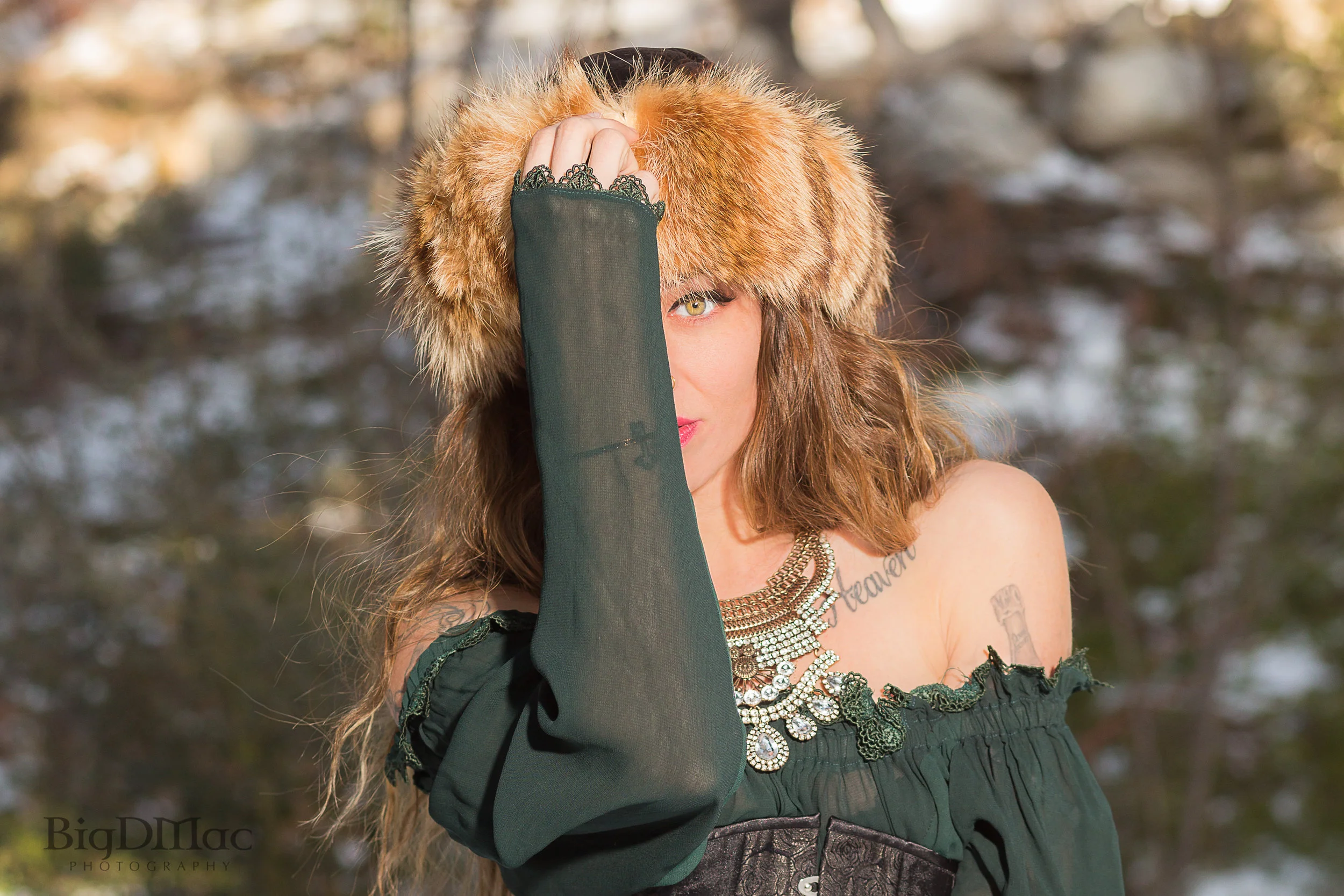
Amanda (above) is a POWERHOUSE in front of the camera, but I don't think she was aware of it until seeing some empowering photos of herself. This is her second time working with me. She was much less nervous this time around, because we had already established a relationship, and she knew how I worked; she knows that I will guide her through every pose. She was ready to go this time around, and her poses show it!
Sometimes a first-time model will have an idea for a theme; go with it! Getting the model to participate in the creative process is half the struggle in getting them emotionally and creatively invested in the experience from beginning to end. Take their original ideas and guide them through what is possible or not, or how you can enhance their ideas even further. First-time models should not be made to feel like their ideas are silly or unimportant for the shoot. And when the end product turns out how they envisioned it, the sense of accomplishment and gratitude are priceless!

This first-time model shyly expressed a desire to have a glam photo shoot with a "forrest fairy" feel to it. We ran with the idea.
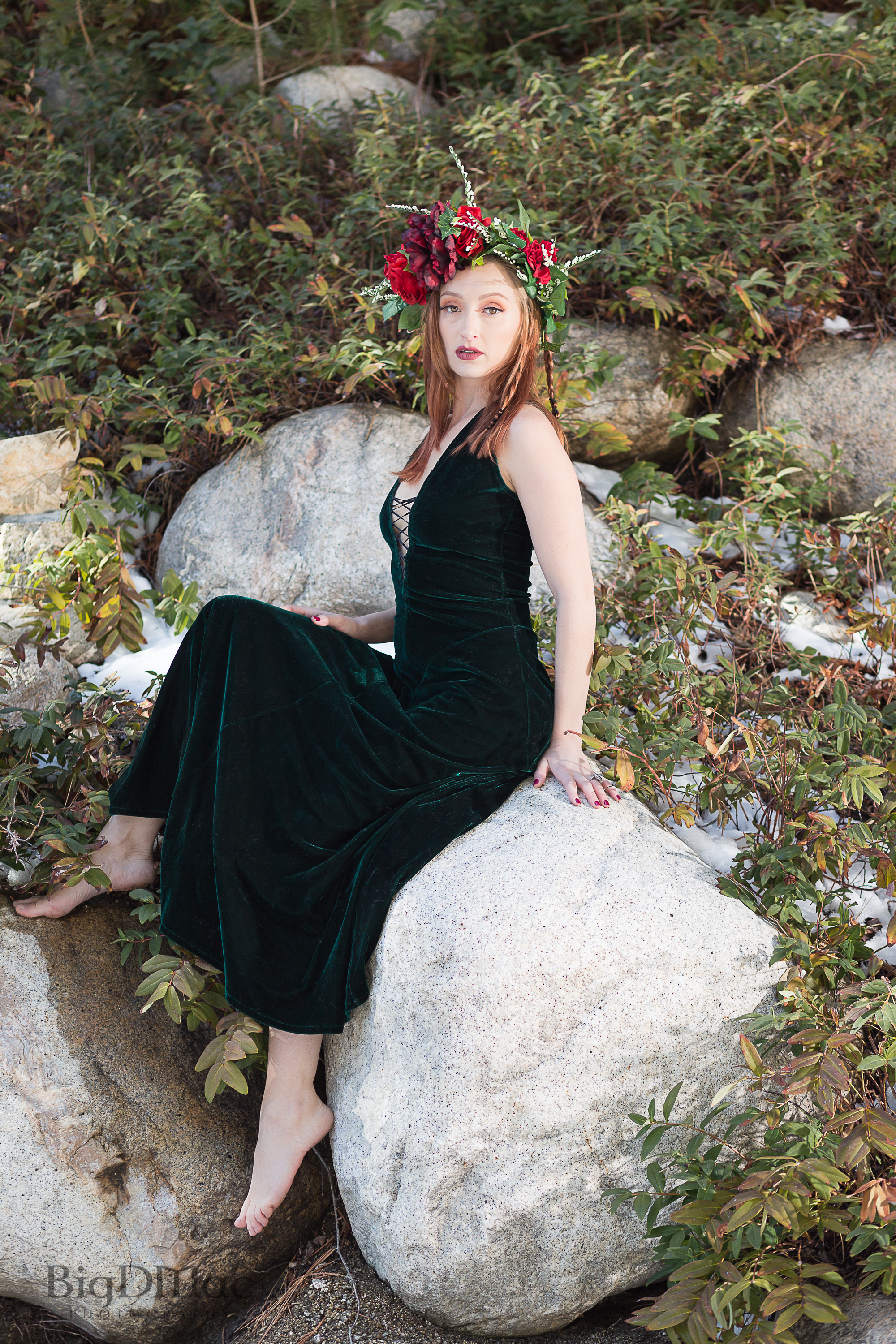
Alley and I (and our crew) think it turned out fantastically! It was very whimsical and "magikal"!
This is a perfect example of working with your model to bring a creative idea to reality. Encourage your models to speak up and step outside of their comfort zones, with you as their sounding board, and an assurance that you will not let them make a full of themselves.
I have found that in these processes and experiences, friendships are forged. We have shared something deep and personal; they have laid their self-worth out on the line with me as their photographer, and that is a HEAVY responsibility! I do NOT take this lightly! I have seen them at their most vulnerable, and I do NOT want to squander their trust in me.


Friendships that get formed with the process of photographing a "non" model from beginning to end has, for me at least, created lasting friendships. We experience something that takes us all out of our comfort zones and requires trust from everyone involved. I would go anywhere with these three (and our host and muse-extraordinaire, Christine Bartley-Williams, who provided the gowns and accessories, the cabin in the mountains, and all the snacks and champagne we could ever want!
Photographing non-models is my favorite thing to do, whether it is for boudoir photo shoots, or glam/fashion shoots like this one. I look forward to exploring me themes with these three beauties, Amanda, Alley, Jamie, and Christine.
Oh---and to be fair, they dressed me up and put ME in front of the camera, too, giving ME directions! They gave me a taste of my own medicine! HAHA!

The Benefits of Professional Collaborations
Often photographers create in a space that may include the client in mind for a future photo shoot (bride, model, family shoot, etc.). Sometimes we forget the insights and perspectives we can gain from the input from our colleagues, or even from novice photographers! Certain community events can stir creative juices, as well, like conquer_la events , photo excursions, like from Paul's Photos Nighthawks or Photo Walks. In these kinds of community gatherings, you find like-minded people to interact with. In that process, what happens is that contact information is exchanged, and one's pool of creative collaborators has just expanded!
I have found that it is in these social get-togethers that my own outlook on the options for creative projects is opened up! For instance, signing up for a local photo workshop allows for trying new techniques in photography in an environment that encourages thinking outside of the box. Learning how to pose models with other photographers is a fun and non-threatening way to learn, and to also understand how you can improve in your own work professionally in your studio. Bring in your friends or family members to pose for you, as I did with my granddaughter in the photo below.

It's sometimes intimidating to learn a new skill, such as how to make a video to advertise your services. Coming together with those curious how to do that and to practice on each other creates not only a tool to use for your business, but also a sense of camaraderie with individuals who have the potential to be long time friends and professional resources. Video advertising is used often now in websites; learning together can often make you laugh and lighten up, and also you can be each others' actors in your videos! I certainly had a good time with my first video (link included) with individuals who are now a part of my photography family. We offer to assist in each others' photo shoots, open homes for on-site location shoots, and to offer perspectives that we may not have thought about on our own.
For instance, this photo below of a pregnancy boudoir shoot was done in the bathroom of one of my photography colleagues whom I met through these very activities I'm describing. She is an accomplished photographer in her won right, too. She happened to have an amazing bathtub for a shoot she knew I was planning. By offering her home, she saved me a lot of money by not having to rent a space, but we also collaborated on ideas for the shoot. She had ideas and angles I didn't think of! I'm hoping in the future to be able to give back to her like she has to me, on more than one occasion!

Grab a group of friends and spend some time in a location taking photos of the local area. Share your shots with each other, and learn! Paul's Photo store in Torrance is well known for these photo excursions, gathering local individuals--whether professional or amateur, novice or experienced--to go out on a night on the town, experimenting with camera settings and compositions of local scenery and people. Some of my closest friends and collaborators have been gained from these causal and fun outings.

Want to learn how to improve your wedding photography? Find seasoned wedding photographers, like Dave Bever, who has made quite a name for himself, not only in the area of seeing photography, but also in drone and real estate photography. Or find someone in your area who is known for their work in another genre of photography, like Boudoir, Children's photography or Pet photography.
See about assisting professionals in your genre of interest. You never know, not only may you learn a thing or two about your own photography techniques, you may also find a friend and collaborator for life!
How to have a Successful at Boudoir Photo Session BEFORE the Session

Boudoir photography seems to be making a resurgence these days. Women of all shapes and sizes, from ages 18-60, are finding new ways to express their sexuality and sensuality in front of a photographer’s lens. (And these days, couples are getting into the act together, too!) The end results are stunning images that have a powerful impact on the client’s self image and confidence levels. But what does it take to make a successful boudoir photo session happen? In my practice, I have found that it takes approximately 2-3 weeks’ worth of preparation for each client to get to the point of actually photographing in the studio. Most clients express an instant apprehension regarding being photographed with very little-or no-clothing on.
At the heart of the matter is the fact that most people do not understand what is involved in boudoir photography in the first place. So, to prepare my clients for what will take place, I have a process that I follow that I have learned through experience over time and from sharing with other professional boudoir photographers and mentors (thank you, #ChristaMeola! and #jenerationsblog.com!) These steps have proven to create an experience for my clients that I believe is second-to-none, and leaves them with a photo session experience and end products that are literally life-changers.

When a potential client contacts me expressing an interest in booking a boudoir session with me, one of the first questions I ask her is “Why do you want to do this?” Often she states that it is for her significant other. As I talk more with her, she soon comes to realize that she is mostly doing it for herself. Sometimes it is a wedding boudoir session she is looking for, or it may be a birthday or anniversary present she is seeking to make. Oftentimes, though, she is wanting to do it for herself, to boost her self-esteem or to celebrate a milestone in her life (turning 40, overcoming a breakup, etc.). Regardless of the reasons, we speak for approximately 30 minutes for our first conversation. I have a list of interview questions I ask her to 1) get a better understanding of who she is as an individual, and 2) to start visualizing a theme, colors, and setting for the kind of boudoir experience that matches her personality. It also helps her to loosen up and to begin to trust me as her photographer. I ask her if she prefers white wine, champagne, or a non-alcoholic beverage. I ask her what her favorite flower is (I always bring a bouquet of the client’s favorite flowers and incorporate it into her session to personalize her experience). We talk about outfits and venues. When applicable, I ask her if there is any object significant to her partner that she would like to include in the session. I stress to her that nudity is an option only, and not expected. That puts clients at ease immediately, and often leads to enough trust to attempt some nudity, after all!
After we go through the list of my interview questions and we have developed a comfortable bond together, we create a joint Pinterest page where she starts to pin photos of posing and clothing ideas that I also have access to, and I look for similar photos to pin and add, too. (She often includes photos from my own website page, as well!) We share this joint Pinterest page together up to one week before the photo session. I have a clear idea of what she has in mind, and she can also see my ideas for poses and outfits. In the meantime, she begins to shop for outfits and props based on the theme we have narrowed down together. It is not uncommon for me to go shopping with her, especially if she is feeling awkward or uncomfortable about shopping for these items, or she genuinely has no idea where to begin. This is actually a fun event! We laugh and giggle and find great things that fit who she is, based on what I have learned about her and what her theme is for her photo shoot. I also share with her some of my props that she may want to incorporate (pearls, stocking, amazing masks, a man’s tuxedo jacket, and a man’s white button-down shirt, to name a few items). I believe that when a client participates in the creation of her photo shoot, she is emotionally (and financially) invested in the experience.

Professional make-up and hair is included in every boudoir session of mine. On the day of the photo shoot, the client brings the agreed-upon outfits and props. She gets the star treatment! While make-up and hair is being applied, she can choose to partake in one glass of the drink of her choice determined during our first interview. She meets my all-female assistants. Everyone treats her like a queen. I take some test shots while she is getting ready, and also to get some candid shots, while at the same time getting her comfortable being photographed before we begin. By the time we actually start the session, she is relaxed, feeling (and looking!) like a million bucks, and we have established a professional friendship such that she trusts me to guide her through each pose and each outfit change. We are close enough friends that she allows me to try various angles and to be playful and daring in a safe environment.
The end results are not only stunning photos to show off to whomever she chooses, but she also has had an experience that she will never forget. One that leaves her feeling beautiful and confident for some time to come! The time invested in this pre-photo session process has been a tried-and-true approach for me. The impact is long-lasting for them, and I find them to be great referrals and return clients for me, as well as becoming life-long friends as an added bonus outcome!